

How to Stay Calm When Your Child Can’t

How to Stay Calm When Your Child Can't — Center for Child Counseling
A Way of Being with HOPE — Article 5

How to Stay Calm When Your Child Can't

A parent's guide to co-regulation

Renée Layman
Renée Layman
President & CEO · HOPE Champion

You've heard the advice a thousand times: "Just stay calm." As if calmness were a switch you could flip while your child screams in the backseat, throws their plate across the kitchen, or dissolves into tears for the third time before breakfast. Staying calm when your child is falling apart is one of the hardest things in parenting. And also one of the most important.

Not because your feelings don't matter — they do. But because your nervous system is the most powerful tool you have. When you regulate yourself, you give your child's brain something it desperately needs but can't produce on its own: a signal that says "we're safe."

This process has a name. It's called co-regulation. And understanding it will change how you show up in your hardest parenting moments.

What Is Co-Regulation?

Co-regulation isn't a parenting technique. It's a biological process. Children are not born with the ability to calm themselves down. That skill — self-regulation — develops over years, and it develops through repeated experiences of being regulated by someone else first.

When your child is overwhelmed, their nervous system looks to yours for cues. If you're escalated — yelling, tense, frustrated — their brain reads that as confirmation: this IS dangerous. Stay in survival mode. But if you're calm — breathing slowly, speaking softly, steady — their nervous system receives a different message: this person is okay. Maybe I can be okay too.

Your child's nervous system doesn't hear your words during a meltdown. It reads your body. Your breathing. Your tone. Your face. That's what tells them whether the world is safe.

This is why "just stop crying" never works. You're asking a child to self-regulate when their brain hasn't built that capacity yet. It's like asking someone to drive a car they haven't learned to steer. Co-regulation is how they learn to steer — by riding alongside you until they can do it on their own.

🚨
When You're Dysregulated
Heart racing, jaw clenching, voice rising
Your child's alarm system escalates in response
Both nervous systems feed each other's stress
The situation spirals — no one can think clearly
🌿
When You Regulate First
Slow breath, soft voice, relaxed shoulders
Your child's nervous system begins to mirror yours
Cortisol drops, safety signals increase
The child can begin to calm — because you did first

Why It's So Hard (And Why That's Normal)

If staying calm during your child's meltdown feels nearly impossible, there's a biological reason for that. Your brain is wired to respond to your child's distress with urgency. Hearing a child cry triggers the same stress response in a parent's brain that a physical threat would. Your cortisol spikes. Your muscles tense. Your own alarm system fires.

On top of that, many of us carry our own childhood patterns. If you grew up in a home where big emotions were punished, dismissed, or ignored, your nervous system may have learned to treat emotion itself as a threat. When your child has a meltdown, it can activate something old and deep inside you — something that has nothing to do with the spilled cereal or the missed nap.

This doesn't make you a bad parent. It makes you a human one. And the beautiful thing about co-regulation is that you don't have to be perfectly calm. You just have to be calmer than your child. That's enough.

Your Calm-Down Toolkit

These aren't just techniques for your child — they're for you. Practice them when you're not stressed so they become automatic when you are.

6 Strategies for Parents
🫁
The Long Exhale
Breathe in for 4 counts, out for 8. The extended exhale activates your parasympathetic nervous system — the one that says "calm down." Two breaths can shift your state.
🤲
Drop Your Shoulders
Most parents carry tension in their shoulders and jaw without realizing it. Consciously dropping your shoulders and unclenching your jaw sends a calm signal to your brain.
🗣️
Whisper
When you feel yourself about to yell, whisper instead. It's nearly impossible to stay escalated while whispering. And a whisper pulls a child in rather than pushing them away.
🧠
The Reframe
Replace "My child is giving me a hard time" with "My child is HAVING a hard time." One sentence. Total shift in how your brain processes the situation.
⏸️
The 5-Second Pause
Before you respond, count to five. The space between trigger and response is where your choice lives. Five seconds is enough to shift from reaction to intention.
💧
The Anchor Phrase
Choose a phrase you repeat to yourself in hard moments: "This is not an emergency." "I can handle this." "My calm is more powerful than their storm." Make it yours.

Co-Regulation in Action

Here's what this looks like in real life — not perfect, but present:

Bedtime Meltdown
Your 4-year-old is screaming because they want one more story. You're exhausted. You feel your jaw clench.
Try this: Take one long exhale. Get down to their level. "I know. You love stories and you don't want to stop. That's hard. We'll read two tomorrow. Right now I'm going to sit with you until you feel calm." Stay. Breathe. Wait.
Grocery Store Explosion
Your toddler wants the cereal box. You said no. They throw themselves on the floor. Everyone is watching.
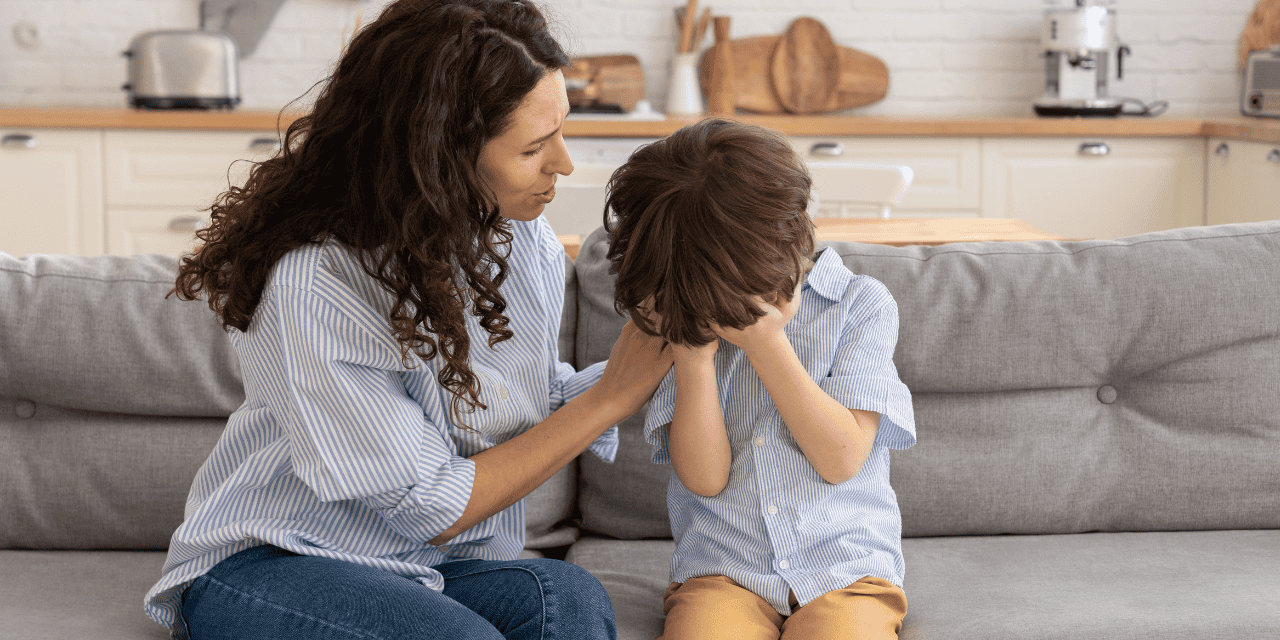
Try this: Ignore the audience. Drop your shoulders. Kneel beside them. "You really wanted that. I hear you." You don't have to fix it. You don't have to explain. Just be the calm. The storm will pass.
Sibling Battle
Your 7-year-old just hit their younger sibling. Again. You feel the anger surge.
Try this: Pause. Reframe: "They're having a hard time." Separate the children calmly. Tend to the hurt child first. Then return: "Hitting isn't okay. I can see you were really frustrated. Let's figure this out together." Teach after calm.
Teen Shutdown
Your teenager slams the door and won't talk to you. You feel rejected and helpless.
Try this: Don't chase. Breathe. After some time, knock gently. "I'm here when you're ready. No pressure." Sometimes the most powerful co-regulation is simply staying available — without forcing connection.

Building Emotional Growth Through HOPE

The HOPE framework identifies Emotional Growth — the development of social and emotional competencies — as one of its four building blocks. Co-regulation is how that growth begins. Every time you calm yourself first and help your child through a hard moment, you're building the neural pathways that will eventually allow them to do it on their own.

Self-regulation doesn't come from being told to calm down. It comes from being shown what calm looks like, over and over, by someone who stays present even when things are hard. That's the gift of co-regulation — and it's one of the most HOPE-ful things a parent can do.

💛
Want more calming strategies or personalized guidance?
Ask our HOPE Assistant for tips, resources, and program recommendations tailored to your child's age.
Try HOPE Assistant →

When You Need More Support

If you find yourself consistently overwhelmed — if staying calm feels impossible most of the time, if you're losing your temper in ways that scare you, or if your child's behavior has escalated beyond what feels manageable — that's not failure. That's a sign that you and your family might benefit from additional support.

Our Tips & Exercises page has calming exercises organized by age group, including a guided calming video. BeKidSafe.org offers free parent workshops on topics like listening, sibling rivalry, and social-emotional learning. And if your child needs clinical support, our Find Support tool can guide you to the right program.

The Bottom Line

You are your child's first and most important co-regulator. Not because you're always calm — you won't be. But because you keep coming back. You keep breathing. You keep trying. And every time you do, you're teaching your child the most important lesson of their life: big feelings are survivable, and you don't have to face them alone.

Put on your own oxygen mask first. Then reach for theirs.

Renée Layman
Renée Layman
President & CEO · Center for Child Counseling · HOPE Champion

Renée has led Center for Child Counseling since 2013, growing it from a small grassroots agency to one serving over 7,500 children annually across Palm Beach County. With nearly 30 years in children's mental health, she is a certified HOPE Champion through the HOPE National Resource Center at Tufts Medical Center, President of the Florida Association for Infant Mental Health, and author of the updated A Way of Being with Children PreK Manual.

Every Child Deserves to Feel Safe & Supported

Whether you're looking for resources, seeking professional support, or simply trying to understand what your child is going through — we're here to help.

The HOPE Framework: What Positive Experiences Actually Do to Your Child’s Brain

The HOPE Framework — Center for Child Counseling
A Way of Being with HOPE — Article 4

The HOPE Framework: What Positive Experiences Actually Do to Your Child's Brain

The science is remarkable

Renée Layman
Renée Layman
President & CEO · HOPE Champion

For decades, the conversation about children's well-being has focused on what goes wrong. Adverse Childhood Experiences. Toxic stress. Trauma. These are real, and they matter enormously. But somewhere along the way, we forgot to ask an equally important question: what goes right?

The HOPE framework — Healthy Outcomes from Positive Experiences — asks that question. And the answer is changing how we think about childhood, parenting, and what it truly takes for a child to thrive.

A Fundamental Shift

The ACEs framework taught us that adversity in childhood has real, lasting effects on health and development. That was groundbreaking — and it led to an entire field of research, policy change, and clinical practice. Center for Child Counseling has been at the forefront of that work through our Fighting ACEs initiative and ACEs Toolkit.

But ACEs alone tell only half the story. Knowing what hurts children doesn't automatically tell us what heals them.

That's the shift HOPE provides:

The Old Question
"What happened to you?"
The HOPE Question
"What's strong with you?"

HOPE doesn't replace ACEs science — it completes it. It gives us a roadmap for building the positive experiences that buffer adversity, change brain architecture, and give every child a fighting chance.

The Four Building Blocks of HOPE

Developed by the HOPE National Resource Center at Tufts Medical Center, the HOPE framework identifies four categories of positive experiences that research shows are essential for healthy development. These aren't abstract ideals — they're specific, actionable, and available to every family, school, and community.

R
Relationships
At least one stable, nurturing relationship with a caring adult — a parent, grandparent, teacher, coach, or mentor — who shows up consistently. This is the single most powerful buffer against adversity. A child who has even one person they can count on develops the neural wiring for trust, emotional regulation, and resilience.
What this looks like: A father who reads to his daughter every night. A grandmother who never misses a soccer game. A teacher who notices when a student seems off and asks, "Are you okay?"
E
Environments
Safe, stable, and equitable physical and emotional spaces for living, learning, and playing. This means neighborhoods where children can play outside, schools where they feel welcome, homes where they feel calm, and communities that invest in the places children spend their days.
What this looks like: A childcare center with warm, responsive caregivers. A neighborhood park that's clean and safe. A classroom where mistakes are met with encouragement, not shame.
E
Engagement
Opportunities for social, civic, and creative engagement — participating in activities that build a sense of belonging, connection, and purpose. This isn't about overscheduling; it's about having experiences that make a child feel like they matter and belong to something larger than themselves.
What this looks like: Playing on a team. Singing in a choir. Volunteering at a community garden. Family game night. Even a simple weekly tradition like pancake Saturdays.
E
Emotional Growth
Opportunities to develop social and emotional competencies — learning to identify and manage emotions, develop empathy, navigate conflict, and relate to others with kindness. These are the skills that allow a child to regulate their nervous system, form healthy relationships, and recover from setbacks.
What this looks like: A parent who names feelings ("You seem frustrated. That's hard."). A classroom that teaches conflict resolution. A family that talks openly about emotions at the dinner table.

What the Research Shows

The science behind HOPE isn't wishful thinking. A landmark 2019 study by Dr. Christina Bethell at Johns Hopkins found that Positive Childhood Experiences — including feeling safe, supported, and connected — independently promote adult mental health, regardless of how many ACEs a person experienced. In other words, positive experiences don't just feel good — they biologically change outcomes.

72%
lower risk of depression and poor mental health for adults with high PCEs — even with ACE exposure
3.5x
more likely to have the social and emotional support needed for health and well-being
2x
better at managing emotions and navigating challenges as adults compared to those with few PCEs

This is what makes HOPE so powerful: it's not about erasing adversity. It's about building something alongside it that changes the equation. A child with four ACEs and four strong building blocks of HOPE has a fundamentally different trajectory than a child with four ACEs and none.

HOPE doesn't replace the work of addressing adversity. It completes it — by giving us a science-backed roadmap for what to build, not just what to prevent.

HOPE at Center for Child Counseling

At Center for Child Counseling, HOPE isn't just a framework we teach — it's how we operate. I became a certified HOPE Champion through the HOPE National Resource Center at Tufts Medical Center because I believe this framework has the power to transform how we serve children and families. Our entire organizational approach — from our A Way of Being with Children philosophy to our community education, clinical programs, and training — is built on the HOPE framework.

Every interaction our team has with a child, a family, or a professional is designed to promote at least one of the four building blocks. When a therapist meets with a child at school, that's Relationships. When we train childcare providers, that's Environments. When a child participates in our ArtClub program, that's Engagement. When SNAP® teaches self-regulation skills, that's Emotional Growth.

HOPE is the thread that connects everything we do.

What HOPE Means for You

You don't need to be a clinician, a teacher, or a policymaker to apply HOPE. You're already doing it — every time you hug your child, show up to a school event, eat dinner together, or simply ask "How are you feeling?"

The HOPE framework gives you the language and the science to understand why those moments matter so much — and to be intentional about creating more of them. Not perfectly. Not exhaustively. Just consistently enough that your child's brain gets the message: I am safe. I belong. Someone cares. I can handle this.

💛
Want to explore how HOPE applies to your family or your work?
Ask our AI-powered HOPE Assistant about the framework, ACEs, positive experiences, and CFCC resources.
Try HOPE Assistant →

The Bottom Line

HOPE isn't about ignoring adversity. It's about refusing to stop there. It's the recognition that what we build for children matters just as much as what we protect them from — and that every parent, every teacher, every community has the power to change a child's trajectory through the simple, profound act of showing up.

Relationships. Environments. Engagement. Emotional Growth.

Four building blocks. One framework. A lifetime of impact.

Renée Layman
Renée Layman
President & CEO · Center for Child Counseling · HOPE Champion

Renée has led Center for Child Counseling since 2013, growing it from a small grassroots agency to one serving over 7,500 children annually across Palm Beach County. With nearly 30 years in children's mental health, she is a certified HOPE Champion through the HOPE National Resource Center at Tufts Medical Center, President of the Florida Association for Infant Mental Health, and author of the updated A Way of Being with Children PreK Manual.

Building HOPE for Every Child

Center for Child Counseling brings the HOPE framework to life through therapy, prevention education, and family support across Palm Beach County.

Why Your Child’s Meltdown Isn’t What It Looks Like

Why Your Child's Meltdown Isn't What It Looks Like — Center for Child Counseling
A Way of Being with HOPE — Article 3

Why Your Child's Meltdown Isn't What It Looks Like

And what to do instead

Renée Layman
Renée Layman
President & CEO · HOPE Champion

The screaming. The crying. The floor-kicking, fist-clenching, back-arching explosion that seems to come out of nowhere. If you've been there — in the grocery store, at the playground, at bedtime — you know the feeling. Exhaustion. Frustration. And that quiet whisper: "What am I doing wrong?"

Here's the answer: nothing. Because what you're watching isn't misbehavior. It's a distress signal.

Behavior Is Communication

This is one of the most important concepts in child development, and it's the foundation of everything we do at Center for Child Counseling: behavior is communication. When a child melts down, their brain isn't choosing defiance. It's overwhelmed. The feelings are too big, the words aren't there yet, and their nervous system has flipped into survival mode.

Think about the last time you were so stressed, frustrated, or exhausted that you snapped at someone — said something you didn't mean, slammed a door, or shut down completely. Now imagine having that same level of overwhelming emotion with a brain that's still under construction, with no words to describe what you're feeling, and no ability to calm yourself down alone.

That's what a meltdown is. Not manipulation. Not a power play. A child drowning in feelings they can't manage yet.

What's Happening in Your Child's Brain
🚨
During a Meltdown
The brain's alarm system (amygdala) has taken over. The "thinking brain" (prefrontal cortex) goes offline. Your child literally cannot reason, listen, or learn right now. Logic, lectures, and consequences won't reach them here.
vs
🌿
After Co-Regulation
Once the child feels safe and their nervous system calms down, the thinking brain comes back online. Now they can hear you, reflect on what happened, and learn from the experience. This is when teaching happens.

A child who is melting down doesn't need a consequence. They need a connection. You can teach the lesson later — but only after their brain is calm enough to hear it.

What Not to Do (and What to Do Instead)

Our instincts in the middle of a meltdown often make things worse — not because we're bad parents, but because we were never taught how a child's brain actually works. Here's the shift:

❌ Instead of This
Yelling "Stop crying right now!"
Explaining why they should calm down
Punishing the behavior in the moment
Walking away or ignoring the child
Asking "Why are you acting like this?"
✅ Try This
Get calm yourself first (co-regulation starts with you)
Get down to their level — physically lower yourself
Validate: "You're really upset right now. I'm here."
Stay close. Your calm presence is the medicine.
Wait. Teach the lesson later, when they can hear you.

The 5-Step Co-Regulation Process

Co-regulation is the process of using your calm to help calm your child. It's not a technique — it's a biological process. A child's nervous system literally borrows regulation from the adults around them. Here's how to practice it:

1
Regulate yourself first
Take a slow breath. Drop your shoulders. Soften your face. You can't help your child regulate if your own alarm system is ringing. Think: "This is not an emergency. This is a child who needs me."
2
Get close and get low
Move toward them, not away. Get down to their eye level. A calm, warm physical presence signals safety to their nervous system — even before words do.
3
Validate the feeling
Name what you see: "You're so frustrated right now" or "That was really hard." You're not excusing the behavior — you're acknowledging the emotion driving it. Children calm faster when they feel understood.
4
Wait for the wave to pass
Big emotions come in waves. Don't try to fix it, rush it, or talk your child out of it. Just be there. Your calm, steady presence is doing the work — even if it doesn't feel like it.
5
Teach after calm
Once the storm passes and their thinking brain is back online, that's when you can talk about what happened, what they can do differently next time, and how to make it right. This is where real learning lives.

Why This Matters for the HOPE Framework

The HOPE framework identifies Engagement — meeting children where they are — as one of its four building blocks. Co-regulation during a meltdown is engagement in its purest form. You're meeting your child exactly where they are emotionally, without judgment, without conditions, and with full presence.

Every time you co-regulate with your child through a meltdown, you're not just getting through a hard moment. You're building the neural pathways for self-regulation — the ability they'll eventually use to calm themselves down without you. You're teaching them, through your body and your presence, that big feelings aren't dangerous, that they don't have to face them alone, and that someone will always be there.

That's not indulgence. That's brain-building.

💛
Need more strategies for managing meltdowns or big emotions?
Ask our HOPE Assistant for personalized tips, resources, and program recommendations.
Try HOPE Assistant →

When Meltdowns Signal Something More

All children have meltdowns — it's a normal part of development. But when meltdowns are frequent, intense, prolonged, or escalating, it may be a sign that your child needs additional support. Signs to watch for include meltdowns that last more than 30 minutes regularly, aggression toward self or others, meltdowns that seem disproportionate to the trigger, and difficulty recovering even with your calm support.

If this sounds familiar, programs like SNAP® (Stop Now And Plan) — our evidence-based self-regulation program for children ages 6–11 — can help. SNAP teaches children concrete skills to recognize their feelings, stop, and choose a better response. Research shows measurable brain changes in just 13 weeks.

For younger children, our Child First and Early Childhood Social-Emotional Supports programs provide home-based and community-based support for families navigating these challenges. And our What Does My Child Need? guided tool can help you find the right fit.

The Bottom Line

The next time your child falls apart — in the car, at the dinner table, in the middle of Target — try to remember: this is not a discipline problem. This is a child whose brain is overwhelmed. They don't need you to fix it. They need you to be the calm in their storm.

And every time you show up that way — imperfectly, exhaustedly, but present — you're not just surviving the moment. You're building their brain. One meltdown at a time.

Renée Layman
Renée Layman
President & CEO · Center for Child Counseling · HOPE Champion

Renée has led Center for Child Counseling since 2013, growing it from a small grassroots agency to one serving over 7,500 children annually across Palm Beach County. With nearly 30 years in children's mental health, she is a certified HOPE Champion through the HOPE National Resource Center at Tufts Medical Center, President of the Florida Association for Infant Mental Health, and author of the updated A Way of Being with Children PreK Manual.

Every Child Deserves to Feel Safe & Supported

Whether you're looking for resources, seeking professional support, or simply trying to understand what your child is going through — we're here to help.

What Children Really Need to Feel Safe

What Children Really Need to Feel Safe — Center for Child Counseling
A Way of Being with HOPE — Article 2

What Children Really Need to Feel Safe

It's not what you think

Renée Layman
Renée Layman
President & CEO · HOPE Champion

We lock the doors. We buckle the seatbelts. We childproof the cabinets. We do everything we can to keep our children physically safe. But the kind of safety that shapes a child's brain, behavior, and future has almost nothing to do with locks — and everything to do with relationships.

Safety, for a child's developing nervous system, isn't about the absence of danger. It's about the presence of connection. A child who feels emotionally safe — who knows that a trusted adult will be there, will notice them, will help them when things feel overwhelming — develops the neural architecture for learning, emotional regulation, and resilience.

A child who doesn't feel that safety? Their brain stays in survival mode. It doesn't matter how good the school is or how structured the routine — a brain on alert can't learn, can't connect, and can't grow the way it's designed to.

The Four S's: What Every Child Needs

Dr. Tina Payne Bryson — the internationally renowned psychotherapist, bestselling author, and keynote speaker at our Lead the Fight initiative — describes four essential experiences that every child needs from their caregivers. She calls them the Four S's:

Dr. Tina Payne Bryson's Four S's
🛡️
Safe
Protected from harm — including emotional harm from the people they depend on
👁️
Seen
Understood for who they really are — their inner life acknowledged and valued
🤲
Soothed
Helped to manage distress when things feel too big — not left alone with overwhelming feelings
💚
Secure
Confident that their caregiver will be there consistently — creating a stable base to explore from

When a child consistently experiences these four things, something profound happens: they develop what researchers call secure attachment. And secure attachment isn't just a nice-to-have — it's the single strongest predictor of a child's ability to handle stress, form healthy relationships, and thrive throughout their life.

What This Looks Like in Real Life

Attachment theory can sound abstract. But in practice, it shows up in the smallest, most ordinary moments — the ones you might not even think about.

Safe
Your child spills their juice and you say, "Oops, let's clean it up together" instead of yelling. They learn that mistakes don't lead to fear.
Seen
Your daughter seems quiet after school. Instead of asking "How was your day?" (and getting "fine"), you say, "You seem like something's on your mind. Want to tell me about it?" She learns her inner world matters.
Soothed
Your toddler is screaming because they can't have a cookie before dinner. Instead of logic or lectures, you get down to their level and say, "I know. You really wanted that cookie. That's hard." They learn that big feelings don't have to be faced alone.
Secure
You drop your child off at a new school and they look back at you. You smile and wave. They know you'll be there at pickup. They walk in with confidence — not because they're not nervous, but because they trust you'll return.

Why This Matters for the Brain

When a child feels safe, seen, soothed, and secure, their nervous system can shift from survival mode to learning mode. The stress response calms. The prefrontal cortex — the part of the brain responsible for problem-solving, empathy, emotional regulation, and decision-making — comes online.

But when a child chronically doesn't feel safe — even if they're physically safe — their brain stays wired for protection. The alarm system stays on. Cortisol stays elevated. And the parts of the brain that handle learning, connection, and emotional growth don't develop the way they should.

A child's brain doesn't ask "Am I safe?" It asks "Does this person make me feel safe?" The answer shapes everything.

This is why the HOPE framework puts Relationships as the very first building block. Not environments. Not programs. Not curriculum. Relationships. Because without a safe, caring relationship at the center, nothing else works the way it should.

What About When You Get It Wrong?

Here's the part that matters most: you don't have to be perfect.

Research on attachment shows that parents don't need to get it right every time — they need to get it right about a third of the time. What matters even more than getting it right is what happens when you get it wrong. Can you repair?

"I'm sorry I snapped at you. That wasn't your fault. I was frustrated about something else." That sentence — offered sincerely — is more powerful than a hundred perfect moments. Because it teaches your child that relationships can bend without breaking. That mistakes are human. That love isn't conditional on perfection.

At Center for Child Counseling, we call this A Way of Being with Children — a way of showing up in relationship that's grounded in attachment science, brain development, and the HOPE framework. It's not about techniques. It's about presence.

💛
Have more questions about attachment, safety, or your child's development?
Ask our AI-powered HOPE Assistant — instant, personalized guidance grounded in our clinical expertise.
Try HOPE Assistant →

When a Child Needs More

For many children, a safe and responsive relationship with a caregiver is enough. But some children have experienced disruptions to that safety — through trauma, loss, neglect, domestic violence, or other adverse childhood experiences — that make it harder for them to trust, connect, and regulate.

That's when professional support can help. Programs like Child First (home-based services for families with children under 6), Infant Mental Health (specialized support for the earliest relationships), and our Child & Family Center (outpatient therapy for children and families) are all designed to rebuild the sense of safety that every child deserves.

If you're wondering whether your child might benefit from support, our What Does My Child Need? guided tool can help you find the right program for your family.

The Bottom Line

The most important thing you can give your child isn't a perfect home, a perfect school, or a perfect schedule. It's you — showing up, paying attention, repairing when things go sideways, and making sure they know, deep in their bones, that someone is there.

Safe. Seen. Soothed. Secure.

That's the foundation. Everything else builds from there.

Renée Layman
Renée Layman
President & CEO · Center for Child Counseling · HOPE Champion

Renée has led Center for Child Counseling since 2013, growing it from a small grassroots agency to one serving over 7,500 children annually across Palm Beach County. With nearly 30 years in children's mental health, she is a certified HOPE Champion through the HOPE National Resource Center at Tufts Medical Center, President of the Florida Association for Infant Mental Health, and author of the updated A Way of Being with Children PreK Manual.

Every Child Deserves to Feel Safe & Supported

Whether you're looking for resources, seeking professional support, or simply trying to understand what your child is going through — we're here to help.

Your Child’s Brain Is Listening: How Everyday Moments Shape Who They Become

Parent and child connecting — Center for Child Counseling
A Way of Being with HOPE — Article 1

Your Child's Brain Is Listening

How everyday moments shape who they become

Renée Layman
Renée Layman
President & CEO · HOPE Champion

You probably don't think of yourself as a brain architect. But every time you comfort your crying toddler, sit down for dinner with your school-age child, or simply listen — really listen — to your teenager talk about their day, you are physically shaping the structure of their brain.

This isn't a metaphor. It's neuroscience.

Your Child's Brain Is Under Construction

A child's brain develops more rapidly in the first five years of life than at any other time. By age three, a child's brain has formed roughly 1,000 trillion neural connections — twice as many as an adult brain. These connections are the wiring that will support everything your child does for the rest of their life: how they learn, how they handle stress, how they form relationships, and how they recover from setbacks.

Here's the part that changes everything for parents: the experiences your child has determine which connections get strengthened and which ones fade away.

Think of it like paths through a forest. The paths that get walked frequently become clear and easy to travel. The paths that are neglected grow over. Your child's daily experiences — the routines, the conversations, the moments of comfort and connection — are carving the pathways their brain will rely on for decades.

It's Not About Being Perfect

If this feels like pressure, take a breath. The research is actually reassuring.

Your child doesn't need perfect moments. They need consistent, good-enough moments — what scientists call "serve and return" interactions. Your baby coos, and you coo back. Your child points at something, and you look together. Your teenager rolls their eyes, and you stay steady instead of shutting down.

These small, everyday exchanges tell your child's developing brain something profound: I am safe. I am seen. Someone is here.

At Center for Child Counseling, we call this A Way of Being with Children — not a set of techniques to memorize, but a way of showing up in relationship with the children in your life. It's grounded in decades of research into attachment science, brain development, and the HOPE framework.

The Science of Positive Experiences

For years, the conversation about children's well-being focused on what goes wrong. Adverse Childhood Experiences — or ACEs — became a powerful framework for understanding how trauma, neglect, and toxic stress can change a child's brain and health trajectory.

But the science has evolved. And the question has shifted from "What happened to you?" to something equally important: "What went right?"

The HOPE framework — Healthy Outcomes from Positive Experiences — developed by the HOPE National Resource Center at Tufts Medical Center, identifies four building blocks that actively promote healthy development and buffer against the effects of adversity:

The Four Building Blocks of HOPE
R
Relationships
Stable, caring adults who show up consistently
E
Environments
Spaces that feel physically and emotionally safe
E
Engagement
Activities that build belonging and connection
E
Emotional Growth
Skills to navigate challenges and relate with empathy

The remarkable finding is this: positive experiences don't just make children feel good in the moment. They change the biology. They build the neural pathways for resilience, emotional regulation, and healthy relationships. They create a buffer that helps children weather adversity — even when life gets hard.

What This Means for You

You don't need to overhaul your family life. You don't need to sign up for a program or read a stack of books. The most powerful thing you can do is pay attention to the moments that are already happening — and lean into them.

At breakfast
Put your phone down and make eye contact. Ask a question. Listen to the answer.
During a meltdown
Resist the urge to fix or lecture. Get down to your child's level, stay calm, and simply be present. Your regulated nervous system helps regulate theirs — a process called co-regulation.
At bedtime
Create a moment of connection. A story. A conversation about the best part of the day. A simple "I'm glad you're mine."
When things go wrong
Repair the rupture. Say "I'm sorry I yelled. That wasn't about you." Children don't need parents who never make mistakes. They need parents who come back and reconnect.

These moments are not small. They are building your child's brain. Every single one.

When Everyday Moments Aren't Enough

Sometimes, despite a parent's best efforts, a child needs more support. Anxiety that won't ease. Behavior that keeps escalating. Grief that lingers. Trauma that disrupts daily life.

That's what we're here for.

Center for Child Counseling provides therapy, prevention education, and family support across Palm Beach County — at our centers, in schools, in homes, and through our Mobile HOPE Unit. We meet families where they are, because we know that the most important work happens in the context of real life.

If you're wondering whether your child might need support, our "What Does My Child Need?" guided tool can help you find the right program or resource for your family.

The Bottom Line

Every parent is already shaping their child's brain. The question isn't whether your daily interactions matter — they do, profoundly. The question is whether you recognize just how powerful you already are.

You are your child's first therapist, first teacher, and first safe place. The way you show up — imperfectly, consistently, lovingly — is the foundation for everything that follows.

That's A Way of Being with Children. And it starts with you.

Renée Layman
Renée Layman
President & CEO · Center for Child Counseling · HOPE Champion

Renée has led Center for Child Counseling since 2013, growing it from a small grassroots agency to one serving over 7,500 children annually across Palm Beach County. With nearly 30 years in children's mental health, she is a certified HOPE Champion through the HOPE National Resource Center at Tufts Medical Center, President of the Florida Association for Infant Mental Health, and author of the updated A Way of Being with Children PreK Manual.

Every Child Deserves to Feel Safe & Supported

Whether you're looking for resources, seeking professional support, or simply trying to understand what your child is going through — we're here to help.

Social media & sharing icons powered by UltimatelySocial