
Every Interaction Builds Resilience
Grounded in the latest brain science, the HOPE framework, and more than 25 years of clinical expertise, this campaign brings accessible, evidence-based tools to the adults who matter most in a young child's life—helping them build safety, connection, and resilience in everyday moments.
Why Early Childhood Matters
How Every Child Can Thrive by Five
Seven-year-old Molly Wright shares research-backed ways parents and caregivers can support healthy brain development — proving that a game of peek-a-boo really can change the world.
Practical Tools for Everyday Moments
Connection Is Protection
A smile at drop-off. A hug before school. These small moments tell a child they're safe and loved, and they build a buffer against stress that lasts a lifetime.
Download the Tip SheetThe Power of Empathy and Presence
When you slow down and tune in, a child feels understood. Being present, without rushing to fix, is one of the most healing things you can offer. Pairs with the Play Is Healing tip sheet.
Download the Tip SheetConnect Before Correct
Children calm down and learn best when they feel connected first. Your steady presence lends calm to a nervous system that's still learning how to settle.
Download the Tip SheetResponding to Challenging Behavior
Every outburst is a child trying to tell us something. Behavior and play start to make sense when you ask what a child needs, and one safe relationship can be the thing that changes everything.
Download the Tip SheetThe Tip Sheet Library
Thirteen practical, one-page guides for the adults in a young child's life. Tap a theme to explore and download.
Connection & Communication
3 tip sheetsBig Feelings & Behavior
3 tip sheetsSafe, Predictable Environments
3 tip sheetsFamily, Community & Caregivers
4 tip sheetsBuilding Family-Teacher Partnerships
Working as a team around a child, across home and school.
Why Family Engagement Matters
How family involvement shapes a young child's development.
Building Community Capacity
Extending a web of support around children beyond the home.
Self-Care for Caregivers
Caring for yourself so you can show up for the children who need you.
Six Pillars of Practice
Foundations of Development
The brain builds from the bottom up — from the brainstem (survival) to the limbic system (emotion) to the cortex (reasoning). In the first five years, over one million neural connections form every second. The quality of these connections depends almost entirely on the relationships and experiences surrounding the child. Understanding this architecture is the foundation of A Way of Being.
Brain Architecture
Three brain regions develop sequentially. The brainstem manages survival. The limbic system processes emotion and attachment. The cortex handles reasoning and self-regulation. Young children operate primarily from the bottom two — which is why they need co-regulation, not logic, when distressed.
Serve and Return
When a baby babbles and an adult responds warmly, neural pathways strengthen. These "serve and return" interactions are the building blocks of healthy brain development. Without them, the architecture weakens — affecting learning, behavior, and health for a lifetime.
Executive Functioning
Skills like impulse control, working memory, and flexible thinking develop gradually through the preschool years. They are not fully mature until the mid-20s. When we expect young children to "use their words" or "make good choices," we are asking them to use brain systems that are still under construction.
Developmental Milestones
Children develop across four simultaneous areas: physical, emotional, cognitive, and social. Progress is uneven and nonlinear. Understanding what is developmentally appropriate helps caregivers set realistic expectations and respond with empathy rather than frustration.
"Brains are built over time, from the bottom up. The basic architecture of the brain is constructed through an ongoing process that begins before birth and continues into adulthood." — Center on the Developing Child, Harvard University
Play Is Healing
Play is the language of childhood. It is how children make sense of the world, process difficult experiences, express emotions they cannot yet put into words, and build the relationships that protect them. For young children, play is not a break from learning — it IS learning. And for children who have experienced adversity, play is one of the most powerful pathways to healing.
Child-Centered Play
Following the child's lead in play communicates "I see you, I hear you, and what you're doing matters." This builds a child's sense of agency, confidence, and trust in the relationship — which are the very things adversity undermines.
Sensory Play
Sand, water, playdough, paint — sensory experiences help children regulate their nervous systems, process emotions through the body, and develop fine motor skills. For children living with stress, sensory play can be profoundly calming.
Therapeutic Play
Play therapy uses the natural language of children to help them express feelings, work through trauma, and develop coping skills. Through carefully selected toys and a trained therapist, children can process experiences they lack the words to describe.
Play as a HOPE Building Block
The HOPE framework identifies safe, stable, nurturing relationships and environments as core building blocks of positive childhood experiences. Play creates both — a safe space where a child feels seen and a nurturing interaction that strengthens the caregiver-child bond.
"Play is essential because it contributes to the cognitive, physical, social, and emotional well-being of children and youth." — American Academy of Pediatrics (2018)
Connection & Regulation
Children do not learn to regulate on their own — they learn through relationships. When a caregiver stays calm in the face of a child's big emotions, the child's brain literally borrows the adult's regulated state. This is co-regulation, and it is the single most important skill a caregiver can offer. Dr. Tina Payne Bryson's 4 S's — Safe, Seen, Soothed, and Secure — provide the framework for building this kind of relationship.
The 4 S's Framework
Safe: Free from harm and fear. Seen: Known and understood for who they are. Soothed: Helped to manage distress and return to calm. Secure: Confident that they can count on you. When children experience all four, they develop secure attachment — the strongest protective factor against adversity.
Co-Regulation
Your calm is their calm. When a child's "lid is flipped" — when the brainstem takes over and the cortex goes offline — no amount of reasoning will help. The child needs your regulated nervous system first. Breathe, lower your voice, get on their level. Connection before correction.
Attachment & Secure Base
A secure attachment relationship gives children a "home base" from which to explore the world. When children feel confident that their caregiver will be there — consistently, predictably, warmly — they develop the courage to take healthy risks, try new things, and recover from setbacks.
The Hand Model of the Brain
When we are regulated, the cortex (fingers) wraps over the limbic system (thumb) — we can think, feel, and respond. When we "flip our lid," the fingers lift and the emotional brain takes over. Young children flip their lids frequently because their cortex is still developing. Adults flip theirs too — and children are watching.
"When children feel safe, seen, soothed, and secure, they develop secure attachment, which is the launchpad for resilience, empathy, and lifelong well-being." — Dr. Tina Payne Bryson, The Power of Showing Up
Behavior & Environments
Every behavior tells a story. When a toddler screams, a preschooler hits, or a child withdraws — they are communicating something they cannot yet express with words. Trauma-informed caregivers learn to look beneath the behavior to the unmet need, the overwhelming emotion, or the dysregulated nervous system driving it. The environment we create — predictable, warm, and safe — is itself a form of intervention.
Behavior as Communication
A child who throws a toy may be overwhelmed by sensory input. A child who clings may be seeking safety. A child who shuts down may have learned that the world is unpredictable. When we ask "what happened to this child?" instead of "what's wrong with this child?" — everything changes.
Connection Before Correction
The brain cannot learn when it is in survival mode. Before addressing behavior, connect: get on the child's level, validate their emotion, and help them feel safe. Only then can you guide, teach, or redirect. This is not permissive — it is neuroscience.
Creating Safe Environments
Predictable routines, consistent caregivers, and physical spaces that feel calming all support regulation. Environments speak to children before we do. A classroom or home that is organized, warm, and consistent communicates safety — even before a word is spoken.
Trauma Responses in Young Children
Children who have experienced adversity may show heightened startle responses, difficulty with transitions, aggression, withdrawal, or regression. These are adaptive survival responses — not willful disobedience. Understanding this distinction is the difference between punishment and healing.
"Children who have experienced traumatic stress often have a sensitized alarm system that gets triggered more easily and more intensely." — Dr. Bruce Perry, The Boy Who Was Raised as a Dog
Caregiver Well-Being
The adults in a child's life cannot offer co-regulation if they are dysregulated themselves. Caregiver well-being is not a luxury — it is a prerequisite for effective caregiving. The manual's "body first" framework reminds us that regulation begins in the body: sleep, nutrition, movement, and sensory awareness are foundational. Caring for yourself is not selfish — it is the most important thing you can do for the children in your life.
Regulation Begins in the Body
Are you sleeping enough? Eating well? Moving your body? Before we can show up for children, we have to check in with our own nervous system. A dysregulated caregiver cannot offer regulation to a dysregulated child. The body comes first.
Secondary Traumatic Stress
Teachers, therapists, foster parents, and caregivers who work with children experiencing trauma absorb that stress over time. Recognizing the signs — emotional exhaustion, cynicism, difficulty sleeping, feeling numb — is the first step toward protecting yourself and the children you serve.
Reflective Practice
Pausing to reflect on our own reactions, triggers, and childhood experiences helps us respond to children from a place of awareness rather than autopilot. What feelings come up when a child screams? When they cling? When they reject you? These reactions carry information.
Your Own ACEs Matter
Many caregivers carry their own history of adversity. Understanding your own ACE score — and the coping strategies you developed — helps you recognize when the past is driving your present reactions. Healing is possible at every age, and it begins with awareness.
"Self-care is not selfish. Do not forget to put your own oxygen mask on, because we need you in this fight." — Dr. Nadine Burke Harris
Partnerships & Special Contexts
A Way of Being extends far beyond the home. Center for Child Counseling embeds HOPE-informed strategies across systems — in schools, childcare centers, pediatric offices, foster care, and community settings throughout Palm Beach County. When every adult in a child's ecosystem practices A Way of Being, the impact multiplies. The child doesn't just have one safe relationship — they have a web of safety.
Schools & Childcare Centers
Teachers and childcare providers are often a child's first consistent relationship outside the home. Training these professionals in HOPE-informed practice transforms classrooms from places of compliance to environments of connection, curiosity, and safety.
Pediatric Integration
Embedding mental health specialists in pediatric offices means families receive screening, support, and warm handoffs to services during routine well-child visits — before a crisis. Prevention happens in the spaces families already trust.
Foster & Kinship Care
Children in foster care have often experienced multiple disruptions to their primary attachments. Caregivers in these settings need specialized strategies for building trust, managing trauma responses, and creating stability when a child's world has been anything but stable.
Cultural Humility
HOPE-informed practice requires cultural humility — the ongoing commitment to understanding how culture, race, language, and lived experience shape both adversity and resilience. What feels "safe" differs across cultures. What "connection" looks like varies. Meeting families where they are means honoring who they are.
"Positive childhood experiences have a dose-response relationship with adult mental health — the more PCEs, the better the outcomes — even in the presence of ACEs." — Bethell et al., JAMA Pediatrics (2019)
Questions About Your Child? Just Ask.
The HOPE Assistant is here whenever a question comes up and you'd like a caring, practical answer. Ask about big feelings, bedtime, tantrums, or simple ways to connect with your child.
Its guidance is grounded in HOPE, Healthy Outcomes from Positive Experiences, the same approach behind A Way of Being with Children. It's a helpful place to start, not a replacement for care from a professional.
Chat with the HOPE Assistant →Resource Library
Your Child's Brain Is Listening
How everyday interactions shape a young child's developing brain, and why the small moments matter more than you might think.
Read →What Children Really Need to Feel Safe
The kind of steady, predictable care that helps young children feel safe enough to explore, learn, and grow.
Read →Connection Is Protection
Simple, everyday ways to build the safe, caring relationships that protect a child through stress.
Download →Play Is Healing
How play helps children make sense of their world, express big feelings, and build confidence and resilience.
Download →Co-Regulation Made Simple
Practical ways to lend your calm to a child during big emotions, so they can learn to settle themselves over time.
Download →Responding to Challenging Behavior
How to read the need beneath the behavior and respond in ways that teach, connect, and build trust.
Download →A Way of Being Videos
Our full library of short, expert-led videos on child development, connection, play, and HOPE-informed strategies for young children.
Watch →A Way of Being Tip Sheets
The complete collection of quick-reference tip sheets on connection, regulation, play, and behavior, ready to download and use.
Browse →Ways to Play
Child-centered play, sensory activities, art, and nature play, all designed to strengthen the parent-child bond.
Explore →BeKidSafe.org Workshops
Self-paced workshops on prevention, child development, and trauma-informed care, available anytime.
Visit Platform →A Way of Being with Children
The PreK edition, the cornerstone manual for parents, teachers, and caregivers, grounded in HOPE and brain science.
Learn More →The Power of Play
Play is how children learn, heal, process their world, and build the relationships that protect them for a lifetime. It is not a break from learning — it IS learning. This collection explores why play matters, how to recognize what children are telling us through their play, and practical strategies you can use today.
Putting Children's Play Themes into Action
Tyne Potgieter, LMHC, NCC explains how to recognize relationship themes in play — connection, trust, approval seeking, and cooperative play — and how understanding these themes helps you validate children and support their emotional growth.
The Power of Play
A practical, downloadable guide with strategies for using play to build connection, regulation, and resilience with the young children in your life.
Download PDF →The Power of Play Workshop
Go deeper with this self-paced workshop on BeKidSafe.org — exploring the science of play, child-centered techniques, and how play supports healing from adversity.
Start Workshop →Ways to Play
Explore our full collection of play ideas — child-centered play, sensory play, art activities, nature play, pretend play, and more for every age and stage.
Explore Activities →Workshops & Events
A Way of Being: Introduction
A foundational workshop exploring the HOPE framework, brain science, and practical strategies for everyday interactions with young children.
Register →Understanding ACEs & Building HOPE
Learn how Adverse Childhood Experiences impact development — and how Positive Childhood Experiences can change a child's trajectory.
Start Learning →Play as a Tool for Healing
Discover how child-centered play builds connection, regulation, and resilience — and how to use play intentionally at home and in the classroom.
Start Learning →Stories of Impact
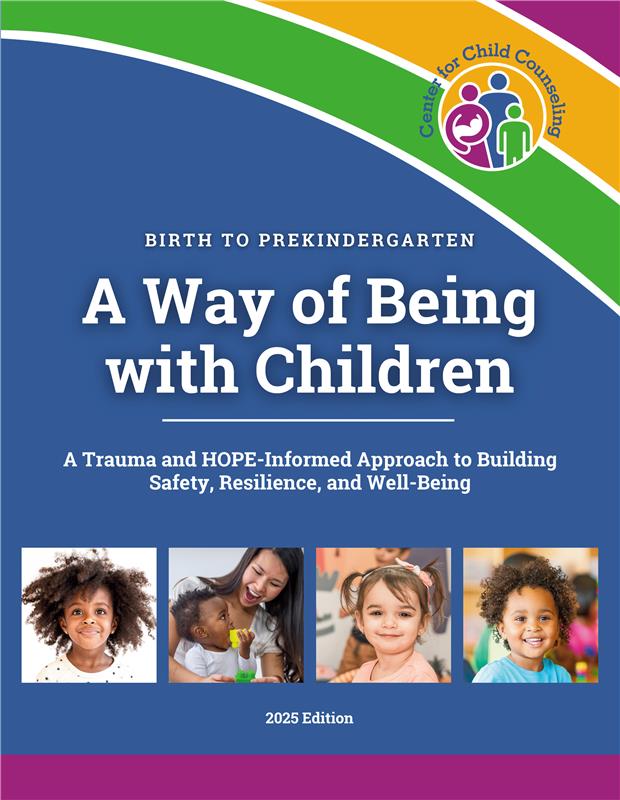
A Way of Being with Children
This manual is the foundation of everything on this page, and the cornerstone of Center for Child Counseling's approach to early childhood. Written for parents, teachers, clinicians, and caregivers, it turns the latest neuroscience, the HOPE framework, and Dr. Dan Siegel and Dr. Tina Payne Bryson's 4 S's into practical strategies you can use in everyday moments with young children.
Grounded in more than 25 years of clinical expertise and the science of early relational health, the newly revised PreK edition adds updated brain research, Positive Childhood Experiences, and reflective practice prompts throughout.
Need Support for Your Family?
Center for Child Counseling provides counseling, education, and prevention services for children and families across Palm Beach County.
Not Sure Where to Start?
Answer a few quick questions and we'll guide you to the programs and resources that fit your family.
Request an Appointment
Connect with our intake team to find the right support for your child and family.
Get Started →Explore Our Programs
From prevention to treatment, we serve children from birth through adolescence.
View Programs →Frequently Asked Questions
Insurance, locations, what to expect, and more, answered in one place.
View FAQs →In crisis? Call or text 988 for the Suicide & Crisis Lifeline. Text 741741 for the Crisis Text Line. Call 211 for local resources. Available 24/7, free, and confidential.
How You Show Up Matters
Every positive interaction between a child and a caring adult builds the brain architecture for lifelong resilience. Start where you are. Do what you can. It all counts.